

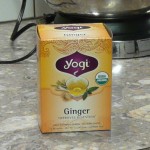
 I bought some ginger tea a little while back, but it turned out a little disappointing. Despite steeping the tea for longer than the prescribed 5–10 minutes, I could barely detect any of the characteristic spicy flavor that I was expecting.
Then a few days ago I decided to give the tea another shot. While water was heating up on the stove, I stuck a teabag in a mug, and added a little milk. I don’t usually put milk in my tea, but I already knew the plain tea was going to be boring. When the teapot started whistling, I poured the boiling water onto the milk/teabag in my mug.
To my surprise, when I started sipping several minutes later, the tea was much more “gingery” than I remembered it. I had a hunch about why, so I embraced my nerdiness scientific leanings and embarked on a study to more rigorously test my hypothesis.
Hypothesis. Milk is better than water at extracting the flavor molecules from ginger tea. Ginger’s signature flavor is attributed to three important molecules (thanks Wikipedia), shown below.
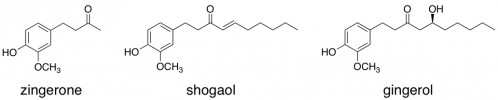
These are all organic molecules, so generally speaking, they are likely to be more soluble in organic solvents than in water. Milk is mostly water, so it’s not truly an organic solvent. However, milk contains a lot of proteins and fats (both of which are organic) that could attract ginger’s flavor molecules.
In theory, ginger tea steeped in milk should taste stronger than tea steeped in plain water, with milk added later:
[TEABAG + MILK + H2O] >> [TEABAG + H2O] + MILK
Experimental Design. Two seemingly identical cups of tea (marked only on the bottoms of the cups) were prepared side-by-side. In one cup, milk was combined with hot water before adding a teabag, such that the milk would be present while the tea steeped. In the other cup, the tea was brewed in plain hot water, and milk was only added after the teabag was removed.
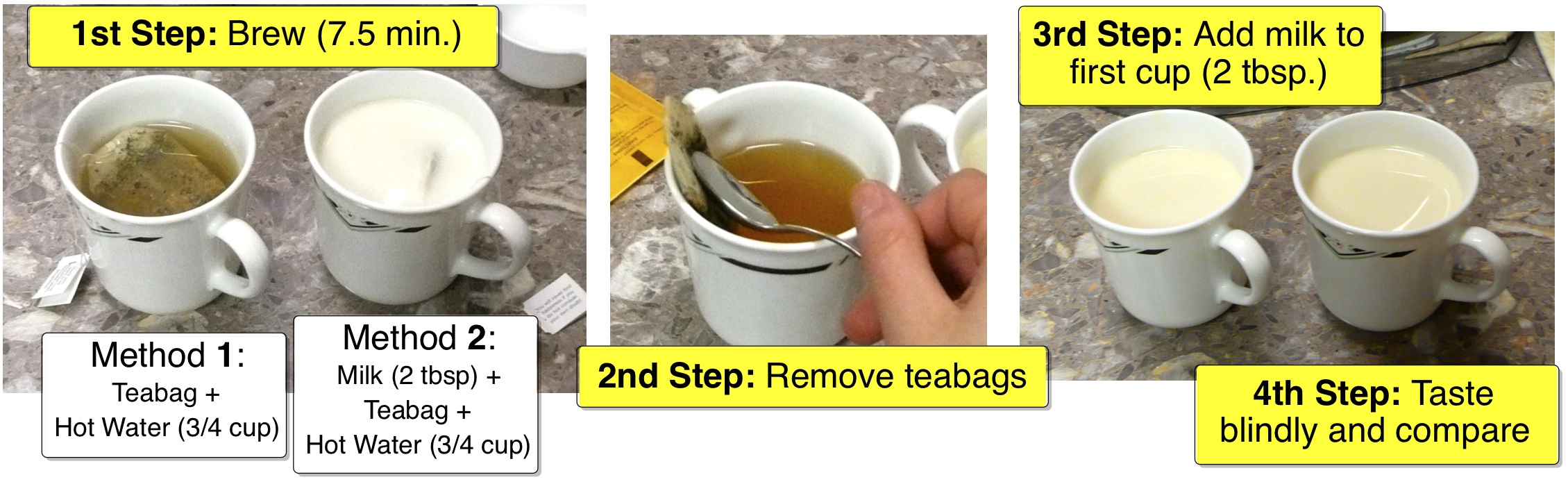
Tea tasting was performed by a volunteer that I managed to recruit. He was blind to the preparation method of each cup of tea, and was simply required to declare which cup (if either) had a stronger ginger flavor.
The experiment was performed in triplicate with the following types of milk: (1) whole milk, (2) skim milk, (3) Half & Half.
Results. The tea steeped in the presence of Half & Half was undeniably stronger-tasting than the normal tea in which Half & Half was added after removing the teabag. Unfortunately, using two tablespoons of Half & Half in 8 oz of tea is really disgusting regardless of preparation method.
Tea brewed in the presence of whole milk also had a stronger flavor than tea with whole milk added post-steeping, though the taste difference was more subtle compared to the Half & Half results. The volunteer taste-tester identified the milk-brewed tea as having a stronger flavor three times out of three.
Even tea steeped with skim milk tasted stronger than tea with skim added after brewing. The volunteer taste-tester identified the milk-brewed tea as having a stronger flavor four out of five times.
 Conclusions. Ginger tea steeped in the presence of milk tastes stronger than tea steeped in plain water. So if you’re going to add milk anyway, do it before brewing. This principle probably applies to other types of tea as well.
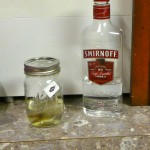
Bonus Info: You can also make ginger vodka from ginger tea. Unsurprisingly, ethanol seems to be really good at extracting flavor molecules, because this vodka turned out very gingery.

14 Responses to My Beverage Tastes Better Because I’m a Chemist