

I began this blog last September as an experiment. Like any good experiment, this particular one was designed to answer a question. Over the past few weeks, I’ve been mulling over the “data” I’ve acquired through this experiment, and realized I have sufficient data to draw a conclusion. Since this blog is about science (and because I’m kind of a nerd), it seems appropriate to share my results in the format of a scientific paper. What follows comes complete with an abstract, so feel free to just read that or skip to the conclusions (like one normally does with scientific papers) if you just want to get the gist of it. There’s also supporting information at the end, with gratuitous pie charts. Here goes:
Abstract
My experience so far with this blog has revealed that I like writing, not for the sake of writing, but because I like trying to explain concepts and relate chemistry to real life. My efforts to write about other people’s research has led me to conclude that I want to be in a career that allows me to stay involved with research. Thus, I’ve determined that I want to pursue a career in academics. With this goal in mind, I really need to focus as I enter the final 1.5 years of grad school, so blog postings will be considerably less frequent.
Introduction
When I applied for graduate school, I had a vague notion that I’d go into academics after I finished. But for the most part, I wasn’t pursuing a PhD because of career aspirations. I simply wanted to study chemistry because I liked it. Really, really liked it. And I’ve been incredibly fortunate to have an advisor who shares surpasses that enthusiasm.
Near the middle of my 3rd year in the PhD program (early 2010), it began to sink in that I was going to graduate someday (i.e., in about 2.5 years) and I needed to figure out what I wanted to do with the rest of my life. The standard career options for a PhD chemist are industry or academics, but there are also the “non-traditional” careers: science policy, patent law, science writing, etc.
There are aspects about each of these careers that I might enjoy. I like teaching. I like thinking about chemistry and coming up with ideas. I like labwork when stuff is working. I like writing. I like mentoring. Sometimes I like debating. But I didn’t feel completely certain about any of the career options. And since choosing your career track is kind of a big deal, it seemed that I needed to start collecting data to figure out what career I could fit into best. After all, I am a scientist, right? This decision should be made scientifically.
I was attracted to the idea of a science communication field. So I decided to start this blog to (a) try my hand at writing about science and (b) to simultaneously answer the following grammatically awkward question:
What is it about science that I most like doing?
Experimental
(Pardon the passive voice in this section, it just feels natural for an experimental.)
 I Can Has Science was started in September 2010, with the initial goal of writing about current scientific research in a manner understandable by non-scientists. This goal was chosen for two reasons: (1) If I wanted to consider science writing as a career, I’d better figure out how to write about science for a general audience, and (2) By restricting my use of jargon, I would force myself to really look at science more fundamentally, rather than getting lost in details.
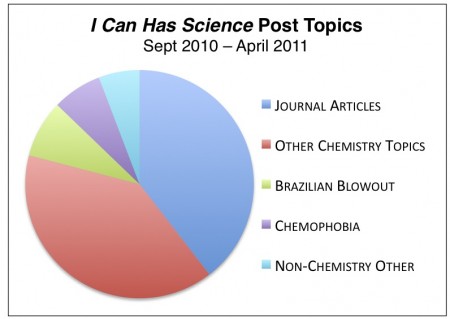
Posts were written an average of 2.53 times per week for a total of (thus far) 34 weeks, typically between the hours of 9 pm and midnight (± 2 h). An effort was made to write frequently about journal articles (usually non-chemistry), but random chemistry topics were written about just as frequently.
Results
While I enjoyed writing about other people’s research, I’ve found that I prefer writing about other random chemistry topics. I like trying to figure out how chemistry relates to real life, and how best to explain ideas. For example, this was probably my favorite post to write.
Furthermore, when I did write about somebody else’s research, I found myself getting distracted from “translating” what they did into non-jargony text. Instead, I wished I could sit down with the authors and ask “Oh did you try this experiment?” or “What do you think would happen if you did this instead of this?” or “Did you run this control?”. I really wanted to get my hands dirty and get involved with the research, not just write about it.
The following observations were made (by me. this passive voice thing is getting out of control):
• I like chemistry better than science-in-general
• I like writing, not for writing’s sake, but for the challenge of explaining concepts and relating chemistry to real life
• I would be discontent with a career that doesn’t allow me to be involved with research
Conclusions
Explaining concepts sounds like teaching. And research sounds like research. When you combine teaching with research… well, that’s called being a professor. Thus I have come full circle and deduced that I want to be a professor when I grow up. The jury is out on whether or not I will ever get there, but I think I have to try.
With this goal now in mind, I really need to focus on doing what I need to do be on the right track. I have a backlog of ideas for blog posts, so I will try to get to them as I have time. But I will be posting less frequently, as it’s more important right now for me to spend my 9 pm – midnight hours doing other things. So, I am not dead. I am just not posting very often : )
Acknowledgments
Chemjobber, Matt, Leigh, Adam, C&EN folks, and others have been super welcoming and supportive as I’ve tried to wedge my way into the blogging community.
My advisor, who has never told me not to do this blog thing. (And is great for many other reasons.)
My technologically savvy mom (site administrator. Also great for many other reasons).
Supporting Information
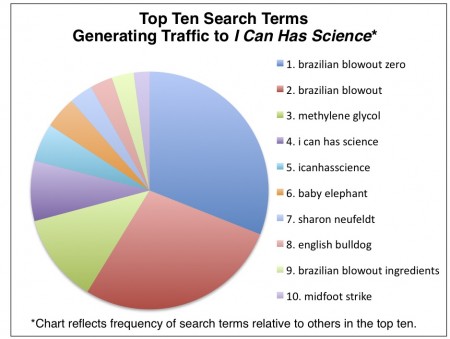
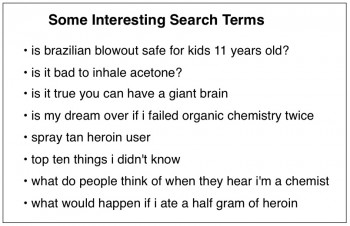
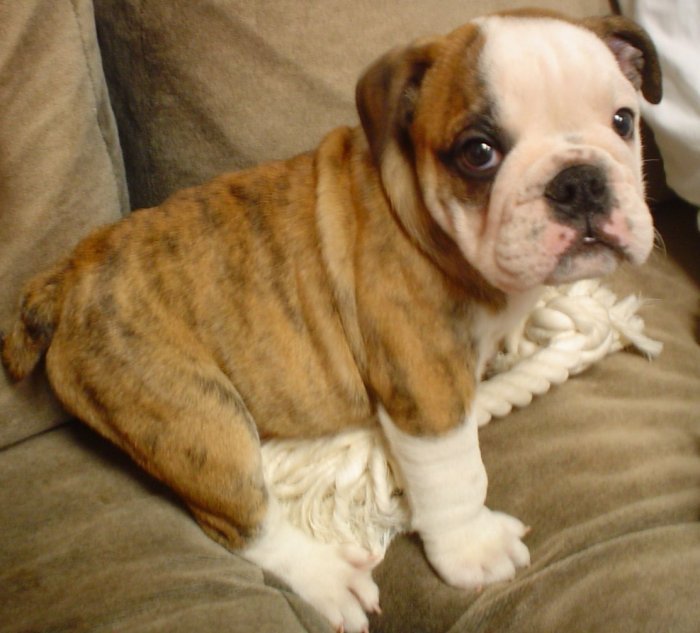
Here are some pie charts and stuff!
14 Responses to What I Want to Be When I Grow Up